
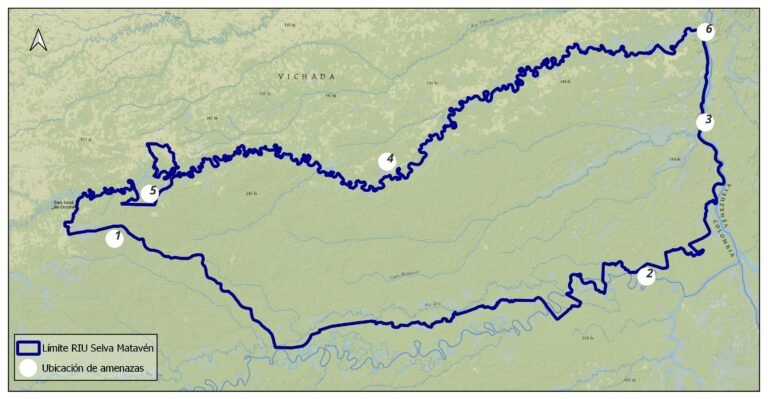
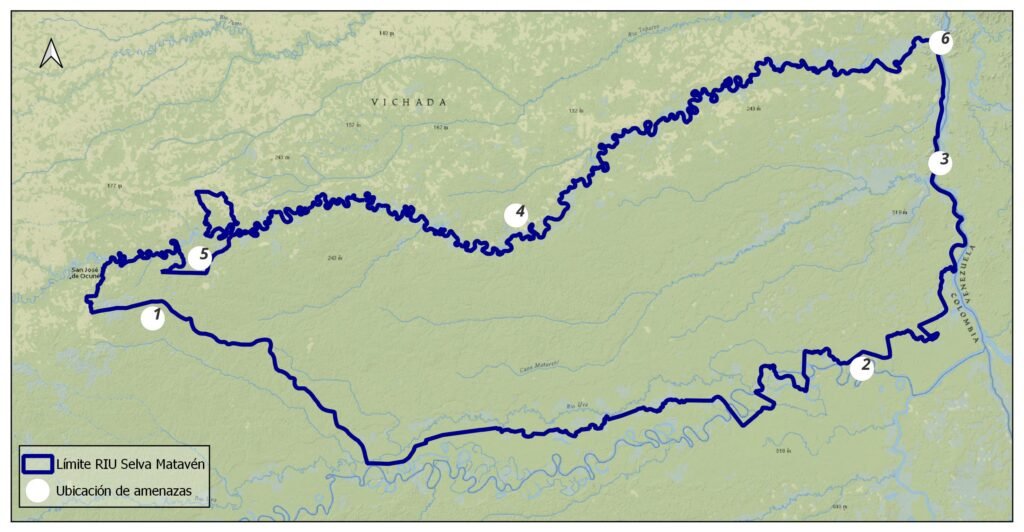
There is a common assumption that sounds logical, almost self-evident: “If Matavén is an Indigenous reserve, the forest was already protected. Why was a REDD+ project needed?”
It is a valid question. But it often stems from a fundamental misunderstanding: the idea that an Indigenous territory functions as an automatic environmental safeguard, capable of holding back external pressures on its own, regardless of how those pressures evolve over time. This interpretation simplifies a much more complex reality.
Understanding additionality in Matavén requires looking beyond historical deforestation data. It requires analyzing the broader context in which the project emerged: the country’s political landscape, shifting territorial dynamics, and the strategic geographic position of the region.
Only through this lens can one fully understand why conservation in Matavén was not guaranteed, and why the REDD+ project plays a critical role.
An Indigenous Territory Protects People, Not Automatically the Forest
In Colombia, Indigenous territories (resguardos) are legal entities designed to safeguard the autonomy, cultural continuity, and collective rights of Indigenous peoples. The 1991 Constitution formally recognizes these territories as self-governed entities with specific rights over land and resource management. This framework is essential. However, its primary purpose is social and territorial, not environmental enforcement.
Indigenous territories do not operate in the same way as national parks, which typically have dedicated budgets, institutional oversight, and enforcement capacity. Interpreting them as equivalent to protected areas often leads to incomplete or misleading conclusions.
In practice, these territories recognize land ownership and governance, but they do not inherently provide the financial, logistical, or operational capacity required to respond to increasing external pressures. This is where the concept of additionality begins to take shape in Matavén.
A Common Misinterpretation: Looking at the Past and Assuming the Future
Historically, Matavén showed low levels of deforestation prior to the project. However, interpreting this as an absence of risk overlooks the nature of deforestation itself.
Deforestation Is a Dynamic Process
Deforestation is driven by multiple, evolving factors:
- territorial accessibility
- expansion of agricultural frontiers
- legal and illegal economic activities
- land pressure
- levels of governance and control
Deforestation hotspots do not remain static. They shift, expand, and intensify over time.
The Strategic Question
The key question was never: “Was Matavén deforesting significantly in the past?”
The real question was: “What dynamics were advancing across the country, and when would they reach Matavén?”
2010–2014: A Turning Point for the Territory
Between 2010 and 2014, Colombia promoted an economic growth agenda centered around large-scale development sectors, including mining, energy, and infrastructure expansion. In frontier regions such as the Orinoco-Amazon transition, this translated into tangible pressure:
- the arrival of external actors
- new extractive opportunities
- expansion of economic activities
- increased interest in land and resource use
Given its strategic location and connectivity, Matavén was directly exposed to these dynamics. The territory did not wait for these pressures to fully materialize: Matavén acted before becoming a deforestation hotspot.
Transition Zones: Where Vulnerability Is Highest
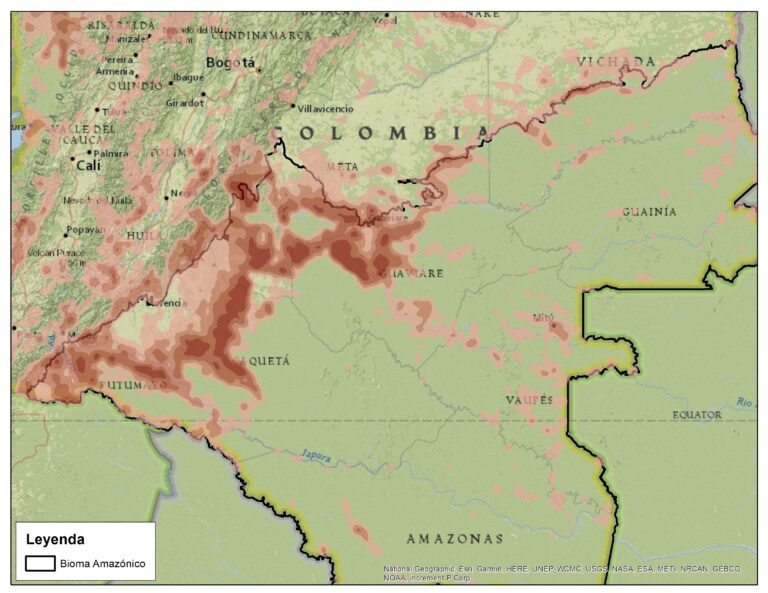
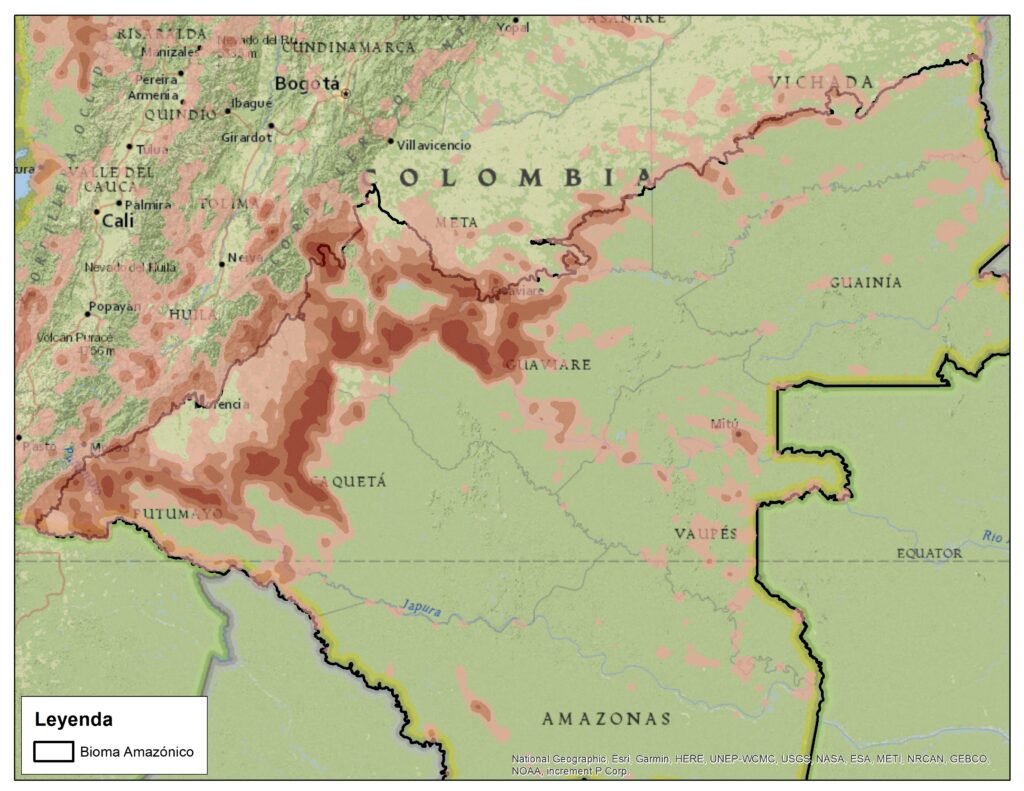
A clear territorial pattern has emerged in Colombia: deforestation tends to concentrate in transition zones. These are areas where ecosystems meet—forest and savanna, Andes and Amazon, Orinoco and Amazon—and where expansion pressures converge most strongly.
The Pattern of Deforestation
In these regions, several factors coincide:
- forests become more accessible
- agricultural frontiers expand
- roads, trails, and river routes emerge
- colonization and land-use change accelerate
Deforestation is not random. It follows geographic and economic patterns.
Matavén: A Transition That Remains Intact
In this context, Matavén represents something increasingly rare: one of the last large-scale transition ecosystems in Colombia that remains intact. This is not due to the absence of risk. It is the result of a deliberate choice.
The Capacity to Withstand Pressure
The territory strengthened its ability early on, building governance, territorial control, and management systems. Analyzing Matavén solely based on historical deforestation, without considering regional dynamics and national hotspot patterns, leads to incomplete conclusions.
“It is similar to assessing a fire by measuring the temperature of a single house, while ignoring that the flames are already spreading across the surrounding area.”
Indigenous Governance: A Foundation That Needed Strengthening
Another common assumption is: “Indigenous communities were already protecting the forest, so there is no additionality.” The key issue is not whether governance existed—it did. The real question is whether it had the material conditions to remain effective under increasing pressure.
The Gap Between Intention and Capacity
The difference between wanting to conserve and being able to sustain conservation often comes down to one factor: resources. Resources that allow moving from a will to conserve to a real capacity to sustain it over time. The REDD+ project does not replace Indigenous governance; it strengthens it and makes it viable over time.
What Additionality Really Means in Matavén
Legal boundaries alone do not stop deforestation. The drivers of deforestation respond to incentives, access, and levels of control. In frontier regions with limited state presence and increasing regional pressure, conservation requires more than legal recognition. It requires a system.
The Scale of the Challenge
In Matavén, more than 22,000 Indigenous people manage a territory of close to two million hectares, including over 1.15 million hectares of tropical forest. This area, comparable in scale to a country like El Salvador, is located in a complex border region with Venezuela.
Expecting a territory of this scale to be sustained through legal frameworks alone, without financial resources, logistical capacity, or continuous territorial presence, does not reflect the operational reality of conservation.
The System That Sustains Conservation
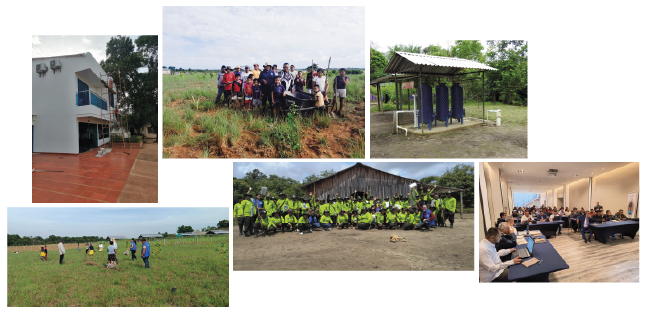
Effective conservation in Matavén is supported by a set of interconnected capacities that require ongoing investment:
- forest monitoring
- organizational strengthening
- territorial control
- field presence
- development of sustainable economic alternatives
This system does not emerge spontaneously. It is precisely this system that the REDD+ project helps consolidate and sustain over time.
Why This Matters for Carbon Credit Buyers
Understanding additionality fundamentally changes how carbon credits are valued. If one assumes that “the forest would have been conserved anyway,” then the credit appears to have little impact. That assumption overlooks a critical reality.
A carbon credit from Matavén does not represent a guaranteed forest. It represents the capacity to sustain conservation in a context of evolving pressures.
What a Carbon Credit Supports
Each credit contributes to maintaining a system that enables conservation to continue, even when political and economic conditions shift, regional pressures intensify, or state presence remains limited. Put simply: it does not fund trees, it sustains governance.
What Changed: The Capacity to Withstand Pressure
Matavén has always had deep territorial knowledge and a strong relationship with the forest. What changed is its ability to sustain that relationship under increasing external pressure. During a decade marked by expansion of extractive activities, conservation required more than intent.
Additionality in Practice
In Matavén, additionality is reflected in a tangible transformation:
- from legal protection to effective protection
- from intention to sustained capacity
- from vulnerability to territorial resilience
If today Matavén remains one of the best-preserved transition regions in Colombia, it is not because risk was absent, but because the territory strengthened its capacity to respond at the right time.